

A LOST DIWALI
- Nov 4, 2022
- 4 min read

On my way home from work one day, I came across some local kids putting finishing touches on a killa (which in Marathi means a fort) they had built. I ask them if I can click a picture and they happily pose alongside their prized creation.
Nostalgia engulfed me and I was transported to the Diwali of my childhood days. All the building/ locality/ gully kids used to gather to build these beautiful tiny or massive forts depending on the size of the gang of children involved. Everyone, big or small used to get involved. Usually larger the number of kids involved, bigger the Killa. The older kids used to gather heavy stones to build the foundation, the smaller ones loose mud, pebbles, water and basically do all the chores the oh- so important older ones passed down. Big strategic discussions on how to build the best fort in the neighbourhood would be held. Pocket-money pooled in to buy the embellishments that consisted of tiny flags, clay mavale (soldiers) and most importantly an attractive Shivaji along with an assortment of clay animals to be scattered around in the forest. Someone used to sow or rather toss tiny mustard or sesame seeds 8-10 days before Diwali and everyone used to take turns to water them so that a live forest would crop up right in time. Everyone also used to fiercely guard all the tiny figurines placed on them.

We used to have loads of fun in between haggling and fighting on how to go about this important project, planning, and doing rounds of friends houses to gorge on the Diwali faral (delicacies)! Looking back, I think this activity that may seem so unimportant taught us children a lot of things. It inculcated a sense of responsibility, team-work, taught us that in life we will not always get our way, made us see things from other children's perspective. Most kids today are lost in their virtual world and will never get to experience this wonderful tradition that we left way behind.
Sadly, this is not the only thing that got left behind. A week before Diwali the air used to be fragrant with aromas of different items of faral (delicacies) from various kitchens in the locality. Laddos of different kinds, Chaklis, Chivdas, Anarse, Chavde, Chirote, Shev, Karnaji, different kinds of Barfis, Shankarpalis, Balushai, and so many other items that are now in forgotten lanes of my memory. It was a riot for us kids. We used to hop on from one house to another and polish off whatever faral we were offered :P
These days you do not hear the happy laughter of satisfied tummies and the pitter-patter of little feet scrambling from one house to another in search of a tasty snack. Diwali evenings, one would see entire families visiting each other to exchange faral and gifts. Hardly anyone prepares the assortment of faral these days that they used to earlier as there are readymade options available at every nook and corner.

Each year during diwali my grandfather used to craft a beautiful lantern (Kandil in Marathi) at home. Every day bit by bit he used to breathe life into the kandil. He would start with the skeleton, build a new wooden frame if the old one had worn out. Then he would stick multi-coloured papers on the faces and then paste a golden cutwork border. With tiny diamond shaped paper cutouts, he would make lovely patterns at the top and bottom and stick dangling paper tails in the end, which after mounting, would sway gracefully in the air. The different coloured papers would ensure dancing colourful shadows on the ground. Even after he passed away, the tradition continued. I am sure this used to be the case in many households till recently when those lovingly made lanterns were replaced with gaudy Chinese plastic ones. Now rarely does anyone take the efforts to make lanterns at home
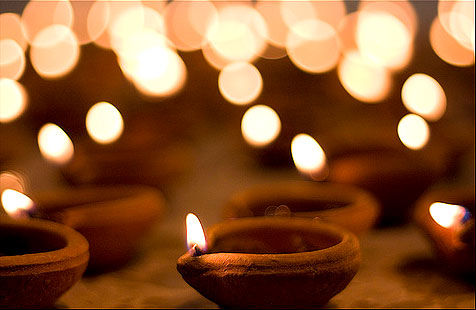
The rows of light also used to be real... Innumerable, lit, tiny clay lamps (called pantya) with oil used to dot the balcony sills or staircases. They are now replaced by less charming tea-lights and electric plastic strings which don't require much effort and are less messy.
Outside every house used to be geru smeared on the floor with dot rangoli on it. The patterns used to change everyday. Hardly anyone has the time or patience for these nowadays. The traditional dot rangolis are replaced by the quicker Sanskar Bharti ones which are quite beautiful too, but the effort is a lot less.

The first morning of Diwali used to be a race of who gets up first, finishes abhyanga snan (bath with fragrant medicated Uthana) and bursts the first cracker in the locality. The lady of the house used to massage her husband and children with coconut oil and fragrant uthana and this is followed by a luxurious bath with reetha or shikekai and soap, which in those days used to typically be either Moti or Camey (the entire process of the oil and uthna massage and bath forms the ritual of abhyanga snan). She used to then perform aarti of all members of the family, make them crush the kareet (which symbollically is the demon Narkasur being killed by the Goddess) and then everyone used to gorge on the faral.
Shopping during Diwali used to be a big affair. New garments used to be bought for everyone during Diwali. Unlike current times when there are umpteen sales that keep happening through the year giving us opportunities to go and splurge every other day, Diwali was the only time when we got a set of new clothes to flaunt, besides birthdays.
How I wish I could go back to the simple home made Diwali which had less flamboyance but more originality, less glamour but a lot of love, demanded more time and effort but was so much more fun! Don't you all agree?
Comments